Making an analogy between computers and theatre is
an interesting yet bold idea because of the lack of connection most people see
in these two fields, and I belong to those people. I started reading this
article with a curious mindset, hoping to find something revealing in the
uncommon analogy of the two remotely related objects. Unfortunately, I have to
admit, after reaching the end of this chapter, I failed to understand the author’s
main purpose of making such comparison between computers and theatre.
A quick research
about the author’s background tells you that she has a PhD in theatre and
worked in computer field after school. In the article, she admits this idea of relating
computers and theatre originated from her PhD dissertation, and that’s probably
where the problem lies. The author uses
the entire first chapter trying to convince readers that computer interface has
something to do with theatre. However, to me at least, this metaphor is only an
alternative to understand a complex concept, and it is only somewhat effective
to people who have knowledge in both theatre and computer science. Considering
the small target audience, I see little meaning in making such laborious
comparison. Maybe this is an interesting idea for the author’s PhD discernment,
but I would not recommend this book to general readers who expect to gain
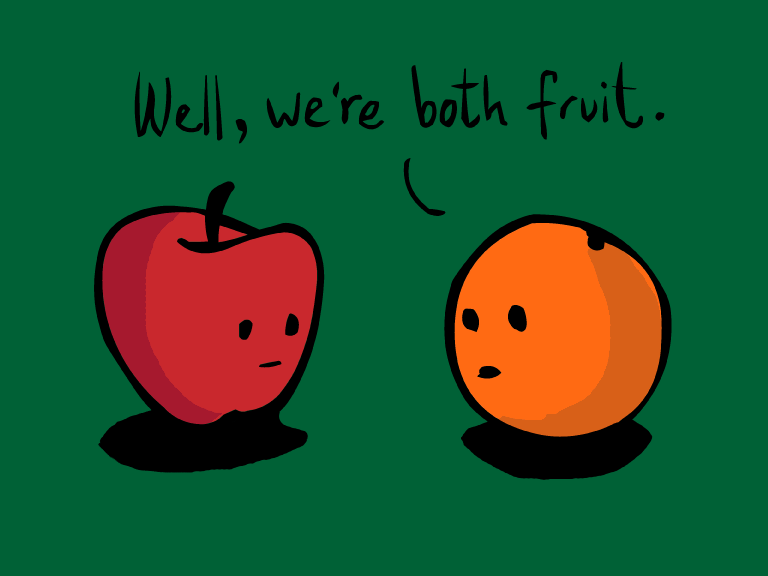
in-depth understanding in computer interface design. In that sense, you can compare computers to anything you are familiar with, be it painting, gardening or cooking. There has got be be a better way of doing that, and I believe the author is totally capable of coming up better metaphors ; in fact, the one she used about looking for information in a library is much more straightforward approach. To be blunt, it feels like the author is trying to convince
readers that apples taste like beef(yes beef, not even orange); even if they do, so what?
Aside from the purpose of this book, I admire the
author’s diligent work on using outside researches and studies to justify her
point. The chapter begins with a brief background on the history of computer
interface design and nicely moves into the debate of the ambiguous definition of
some key concepts in interface design. We’ve learned from the author that
interface design is an interdisciplinary field that covers topics from
linguistic to industrial design and of course, psychology. Personally, I am
particularly interested in the overlap between computer science and psychology,
and how the findings in one field mutually deepens the understanding of the
other.

Cognitive psychology witnessed its fast development
in 80s and 90s of last century, a period when computers are becoming increasingly
popular in ordinary people’s life. As computer engineers kept trying to
computers more effective and user-friendly, cognitive psychology was used tool
to understand and analyze how humans perceive and react to outside information.
On the other hand, the advancement of computers also inspired cognitive
psychologist to rethink how people’s cognition (including perception,
attention, knowledge-learning and decision-making etc.) works. At the golden
age of cognitive psychology, many cognitive models are developed to explain how
people’s cognition system work, and unsurprisingly, a lot of those resembled how
computers process information. Don Norman, who has been involved in designing several Apple products, as pointed out in the article, is
a pioneer in this field, and his milestone book of “The Design of Everyday
Things”(originally named “Psychology of Everyday Things”) is still a must-read
for todays’ students studying design, psychology and HCI (Human-Computer
Interaction) etc. Apparently, the development of computer science and cognitive
psychology enhanced the further understanding of the other field mutually. As a consequence, the better understanding
of both fields led to the significant improvement of interface design. In fact,
a new field of study called “cognitive science” that includes anthropology,
neuroscience, cognitive psychology, computer science (artificial intelligence
in particular) and philosophy is also gaining increasing interest by scientists
in various fields. We can easily foresee that interface design will be going
through some exciting evolution in the coming years.
Last
but not least, a bit off-topic probably, the book as a whole illustrates the value
of liberal arts education. The author studied theatre, worked on computers, and
found the connections between those and turned her findings into a book. Doesn't that sound kinda cool?

No comments:
Post a Comment